

 English
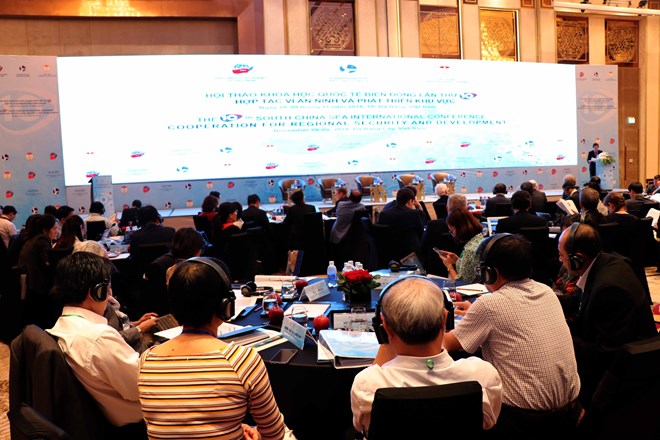
At the event (Photo: VNA)
The 10th South China Sea International Conference, themed “Cooperation for Regional Security and Development”, opened in the central city of Da Nang on November 8, bringing together over 250 domestic and foreign scholars, academics, and diplomats.
The event was co-held by the Diplomatic Academy of Vietnam (DAV), the Foundation for East Sea Studies (FESS), and the Vietnam Lawyers’ Association (VLA) to review the latest developments, identify the drivers behind tension and stability, and explore different avenues for conflict management and resolution in the East Sea region.
Marking the 10th anniversary of the inauguration of the initiative, this year’s conference will also move beyond an annual review to take stock of the transformations in the East Sea across many sectors over the last decade.
The event includes eight sessions, entitled “East Sea: the Heart of the Indo-Asia-Pacific Region”, “East Sea in the Spotlight: a 10-Year Recap”, “Evolving Claims and Positions over the East Sea: Continuities and Changes”, “Major Powers: Engagements or Disengagements?”, “The Buildup of Forces in the East Sea”, “Confidence Building”, “Preventative Diplomacy”, and “Dispute Resolution, Order, and Disorder in the East Sea: Reflections”.
In his opening remarks, DAV President Assoc. Prof. Dr. Nguyen Vu Tung, said that the last decade has seen increased connectivity between the Pacific and Indian Oceans, featuring great impacts on politics of Asia and the world at large in the 21st century.
The first session will discuss the geopolitical context of the Indo-Asia-Pacific Region to evaluate the importance of the East Sea in global geopolitical competition and to explore the links between events in the East Sea and recent developments in the Indian Ocean, Pacific Ocean, and East China Sea, as well as the regional political landscape.
The second session will review the current situation of the East Sea compared to its position 10 years ago to see how it has changed over time in the eyes of various governments and concerned parties, said Cleo Paskal who is Associate Fellow at the Department of Energy, Environment, and Resources, as well as at the Asia-Pacific Programme at Chatham House in the United Kingdom.
Paskal, who is also the moderator of the session, added that the session will also examine various ways of reporting a historical incident in order to identify the similarities and differences in the mindset, perception, and interpretation of the event and how the truth has been twisted only to further complicate the situation.
The third session will provide a summary of the positions and claims of concerned parties over the past ten years, during which speakers will analyse official statements and legal documents of each side to see how they changed their approaches to applying and interpreting the law of the sea, noted Prof. Robert Beckman, head of the Ocean Law and Policy Programme at the National University of Singapore’s Centre for International Law.
In the sixth session, delegates will look at the process of confidence building, preventative diplomacy, and dispute resolution in the East Sea, said the US Department of State Assistant Legal Adviser for East Asia and Pacific Affairs Robert Harris.
Though tensions have always existed, the last decade saw some positive developments, particularly when ASEAN and China started negotiations on a Code of Conduct in the East Sea in early 2018. The two sides have also launched an emergency hotline and discussed the expansion of the Code for Unplanned Encounters at Sea (CUEs). Meanwhile, some involved parties are discussing the possibility of joint exploitation and demarcation at sea.
The participants will also propose solutions to maintain a secured region for all parties to grow together in the future.
The conference will run through November 9.
Source: vietnamplus.vn
TỔNG ĐÀI DỊCH VỤ CÔNG: (0236) 1022 hoặc *1022, miễn phí phục vụ
1. Đường dây nóng tiếp nhận ý kiến phản ánh, góp ý của tổ chức, công dân.
2. Hướng dẫn, giải đáp quy định, chính sách, thông tin kinh tế – xã hội.
3. Hướng dẫn thực hiện thủ tục hành chính, dịch vụ công trực tuyến.
4. Cung cấp thông tin về hỗ trợ doanh nghiệp; quy định, chính sách hỗ trợ Khoa học công nghệ, đổi mới sáng tạo và chuyển đổi số.
5. Cung cấp thông tin về du lịch, sự kiện Văn hóa – Thể thao.
6. Cung cấp dịch vụ Tổng đài CSKH, nhắn tin CSKH, truyền thông, sự kiện và các dịch vụ tư vấn khác…